Uncategorized
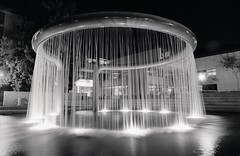
The Hoop Fountain is located between Meyer and Green Libraries at Stanford. During the day, it can be little more than an interesting shape, painted with a nice red color. It gleams, but it doesn’t overwhelm, like the Claw in White Plaza.
However, at night, they light up the streams of water, and the glow around the fountain can be really impressive.
I took this photo during my first photography class. My wife had a night photography assignment and I took her materials and went out for a stroll around campus. I eventually settled myself down low on the steps that drop down towards the actual water level, managed to step on quite a few slugs (yuck), and got a few pictures that I really liked. This is my favorite of the black and white ones.
I’m surprised I haven’t blogged about this before. Or, if I did and just can’t seem to find it while searching on my blog…well, it deserves a second post
.
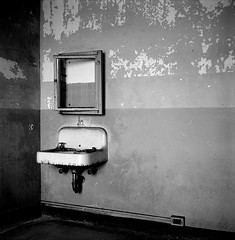
While walking around in the usually-off-limits Hospital section of Alcatraz, I came upon a number of worn out, beat up rooms that used to be for medical treatments, examinations, etc. This particular one had this sink, all rusted over, along with a now-mirror-less medicine cabinet.
When it comes to photos I have taken of abandoned, run-down locations, this is by far my favorite. This photo conveys exactly the feeling I wanted – worn out, the peeling paint, the slightly ajar medicine cabinet door, even the old plug in the corner (so the right side of the frame isn’t entirely empty). It feels abandoned, a place left behind a long time ago. Not just in disuse but in disrepair. No one cares about that sink anymore.
Technically, it also has a nice range of tones, I think, and is a very sharp negative.
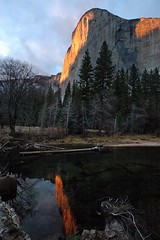
Just kind of a random thing – a web page called “the circumference” that seems to cover a number of topics is using a couple of my photos of Yosemite, including this one as the primary one, for their El Capitan page. My photos are on flickr via a Creative Commons license that requires that users give me credit and cannot alter the image, but can otherwise use them without explicit permission.
It’s just kind of nice to have a photo used for something. And actually it made me take a 2nd look at this one, which I rather like to boot ![]()
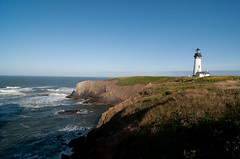
As I’m sitting in my windowless office today, very tired mentally and physically from what seems like an overwhelming flood of information that has come my way, this photo of Yaquina lighthouse helps calm my tense nerves.
We had driven by this picturesque lighthouse the previous day, on the way to Depoe Bay, with the intention to go back when the sun was setting. However, the view from our own deck at the Whales Rendezvous B&B was so amazing that we just stayed there.
So, being the crazy person that I am, I got up early the next morning and drove the 10 minutes back to Yaquina head for some almost-sunrise photography (sunrise was about 5AM, so 6:30 felt close enough…).
The wind was incredible. Quite literally – if someone else recounted the tale of how windy it was on that bluff, I would not find the store credible. I truly felt that I was going to be blown right off into the ocean.
At the same time, here was this beautiful lighthouse, on a remarkably lush bit of rock (the mystique of lighthouses tends to make people forget that they are built to keep boats away from rocky, dangerous, hard-to-reach and often quite ugly areas – this one was in a much nicer location). The sun was beautiful (though did nothing against the cold of the wind) and as I approached the stairs leading down to the beach for some different angles, I looked over my shoulder and found this.
Even with the memories of that ridiculous wind, this photo warms my spirits as I think of the clear skies, the early sun, and the picturesque lighthouse.
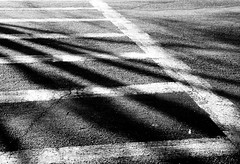
I bring a camera along with me on my “commute.” I use quotes because I walk to work and, while I try to vary things up a bit, I pretty much walk across one major street, then among residential streets the rest of the way. So I try hard looking for interesting lighting, lines, shadows, patterns, and textures. I find myself aiming my lens at the ground a lot, to be honest (not that I don’t get some photos from that).
I apparently am enthralled by crosswalks, as I have an inordinate number of photos of the three that I run into during my walk. This particular image is actually on color slide film, scanned, then converted to black and white. I think that helps bring out the lines even more in the images. Who knows…
The Nikon D50, one of the best digital SLR’s Nikon has produced, in my opinion, was our first DSLR. We got it right before a wonderful Hawaii vacation in January 2005.
When I was ready to upgrade, the D50 was selling for maybe $250 or so. Not really worth it, to be honest. And it wasn’t worth it to keep around as is since I was making a pretty big jump. So I decided to pay $150 to have it converted over to an infrared-only camera. It is only sensitive to the near IR spectrum of light and allows me to shoot handheld. Usually, one gets really long exposure times when doing digital IR.
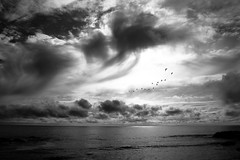
The conversion has produced some really useful applications. One is with skies. The clouds become even more dramatic against an IR darkened sky. Conversion to black and white makes it all the more dramatic, I think. Also, because we have a more sensitive camera in the first place, I can take shots where birds and other moving objects are frozen and still.
It’s actually kind of a funny process, shooting digital IR. IR sensors are inherently overly sensitive to near IR spectrum of light. So manufacturers put a “hot filter” over the sensor, which blocks that part of the spectrum. Those that want to do digital IR then put an IR filter, which blocks most of the visible spectrum, in front of the lens so that only the near IR comes through. This means that a tiny sliver of the spectrum actually hits the sensor. Which means incredibly long exposure times.
In a converted camera, the hot filter is taken away and, in my case, replaced directly with an IR filter. So now it’s just a straight, near-IR-only camera with great sensitivity.
I recently acquired a new macro lens, the Sigma 150mm 2.8. A macro lens is one that is able to reproduce the subject at a “life size” ratio. This means that the object in real life is the same size as it is on the film or digital sensor. This means REALLY BIG. It also tends to mean up close, though that is a side-effect, not a requirement.
There are many zoom lenses out there that claim to have “macro” capability but that really means it can focus closer than perhaps others, but can only produce something that is 1/4 or 1/5 of life size. Not true macro.
The thing about this new lens is that I get more “working distance.” Shorter macro lenses put one almost right on top of the subject – literally inches away. I can be almost a foot away (maybe 8-10″) and still be at or near life size. This gives me a lot more freedom, to say the least, and gives me more natural lighting (I am less likely to block the light myself, etc).
This also means that standing at any normal distance from a subject is getting really close to life size, which means focusing is really tough. This is one of maybe 25 photos of this flower that came out with reasonable sharpness. And as you can see, while that petal on the right side is probably not more than 5mm in front of the stamen, it’s blurry and out of focus.
I am extremely happy with this lens, though it will take some getting used to. It is extremely sharp, easy to handle, and produces very rich colors with nice saturation and contrast. It opens up new options as far as macro photography, which is a wonderful thing to have.
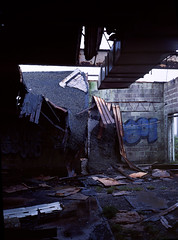
Sweeney Ridge, recently added to the Golden Gate Recreation Area, is an interesting park. First, the on major trail is paved for a big portion of the way. Only after you have climbed up steadily for about an hour (really kills the legs) does the trail split. One way heads towards the point where the bay was first seen by explorers…a long time ago. The other continues along the paved path towards a Nike Missile Radar Station, long since abandoned. What’s amazing about these empty buildings, falling apart with graffiti and caved-in ceilings is that they are completely accessible. One can walk right in and wander around the carnage.
Sometimes, it really does help to be composing in a particular format.
My panasonic LX3 has a “16×9″ mode that gives me this panoramic look. Even though I know I can take the regular, full frame and crop it, looking at the screen while in 16×9 makes you see things differently, I think.
In this case, I could feel the symmetry of the mountains on either side with the boat in the middle much better, I think, than if I had a much more square frame and just tried to visualize.
This was taken while sitting on Bophut Beach on Koh Samui, in Thailand.
Alameda, by Oakland, is a little island that used to be one giant naval base. The vast majority of repairs for the Navy took place there, apparently (I’m still looking up the history for more details). It hasn’t been used for that purpose for quite a while and the various hangers and buildings there are now used for all kinds of reasons. There is one hanger that is some kind of super-sized sports facility, for instance. All around the hanger is fencing blocking off other restricted areas – just yards away. Playing indoor bocce with a restricted access construction area just outside. Pretty weird.
The old traffic control tower building, shown here well after the sun had set, is now the home of a wind energy company. Of all the places to use as a company headquarters…